Analyzer
Overview
语义分析任务
语义分析: 将以 RawStmt 节点为根的原始解析树(Parse Tree),转换为 Query 节点树
-
相关函数:
parse_analyze_fixedparams -
核心流程
RawStmt/parsetree ----> parse analysis(analyze.c) + ParseState ----> Query
-
关键结构:
-
ParseState: 语义分析的工作上下文(working context),转换ParseTree为Query结构的临时结构,生成Query后丢弃
/* State information used during parse analysis */
struct ParseState
{
    const char *p_sourcetext;   /* source text, or NULL if not available */
    List       *p_rtable;       /* range table so far */
    List       *p_joinexprs;    /* JoinExprs for RTE_JOIN p_rtable entries */
    List       *p_joinlist;     /* join items so far (will become FromExpr node's fromlist) */
    List       *p_namespace;    /* currently-referenceable RTEs (List of ParseNamespaceItem) */
    ParseNamespaceItem *p_target_nsitem;    /* target rel's NSItem, or NULL */
    int         p_next_resno;   /* next targetlist resno to assign */
    /* ... */
};
Query
typedef struct Query
{
    NodeTag     type;

    CmdType     commandType;    /* select|insert|update|delete|merge|utility */

    /* where did I come from? */
    QuerySource querySource pg_node_attr(query_jumble_ignore);

    /* ... */
    Node       *utilityStmt;    /* non-null if commandType == CMD_UTILITY */
    /* ... */
    List       *rtable;         /* list of range table entries */
    /* ... */
    List       *targetList;     /* target list (of TargetEntry) */
    /* ... */
    Node       *havingQual;     /* qualifications applied to groups */
    /* ... */
} Query;
查询分类
transformStmt 处理三种不同查询 select(select into 会被视为 create table as,在 transformOptionalselectInto 中处理)
exec_simple_query - pg_analyze_and_rewrite_fixedparams - pg_analyze_and_rewrite_fixedparams
    transformTopLevelStmt - transformOptionalselectInto
        transformStmt
            | transformValuesClause      /* values (1, 2); */
            | transformselectStmt        /* select a, b from tb; */
            | transformSetOperationStmt  /* select a, b from tb union values (1, 2);*/
DROP TABLE IF EXISTS tb;
CREATE TABLE tb  AS select n AS a, n * 10 AS b, n * 100 AS c FROM generate_series(1, 5) AS n;
select a, b FROM tb where a = 2;
对象层级关系
| 层级 | 中文名称 | 核心作用 | 唯一标识 | 关联系统表 |
|---|---|---|---|---|
| Database | 数据库 | 最高级隔离单元(独立的系统表集合) | OID |
pg_database |
| Schema | 模式 / 名称空间 | 数据库内的逻辑隔离单元 | OID |
pg_namespace |
| Relation | 关系 | 模式内的核心对象(表/索引/视图等) | OID |
pg_class |
| Column | 字段 | 关系内的最小数据单元 | OID+attrnum |
pg_attribute |
参考文档:
- https://postgres-internals.cn/docs/chapter01/
- https://www.interdb.jp/pg/pgsql01/02.html
- download pdAdmin 4
查询分析总体流程
transformselectStmt
transformselectStmt
    transformFromClause         /* from tb */
    transformTargetList         /* select a, b */
    transformWhereClause        /* where a = 2 */
    transformSortClause
    transformGroupClause
    transformDistinctClause
    transformLimitClause
    transformWindowDefinitions
    transformLockingClause
    /* ... */
分析表名 from tb
函数: transformFromClause(pstate, stmt->fromClause); + transformFromClauseItem
任务: Process the FROM clause and add items to the query's range table, joinlist, and namespace.
表的多种抽象形式
- 文本标识:
tb --- Identifier —— RangeVar - 语法分析:
RangeVar --- selectStmt::fromClause - 语义分析:
RangeTableEntry --- ParseState::p_rtable --- Query::p_rtable - 名称空间:
NamespaceItem --- ParseState::p_namespace - 优化结构:
RelOptInfo: TODO - 关系缓存:
Relation ---- relation_open() - 持久数据:
pg_class+pg_attribute,pg_attrdef,pg_index,pg_constraint,pg_rewrite, ...
SQL: FROM tb
   ↓
RangeVar       —— 名字
   ↓
RangeTblEntry  —— 语义对象(作用域)
   ↓
Var            —— 列绑定(编号)
   ↓
RelOptInfo     —— 优化对象(代价)
   ↓
Relation       —— 物理对象(存储)
Query查询树中的关键抽象: Range Table(范围清单) : A range table is a List of RangeTblEntry nodes.
typedef struct Query
{
    /* ... */
    List   *rtable;  /* list of range table entries: RangeTblEntry */
    /* ... */
} Query;

typedef struct RangeTblEntry
{
    RTEKind     rtekind;  /* Range kind */
    Oid         relid;    /* OID of the relation */
    char        relkind;  /* relation kind */
    /* ... */
} RangeTblEntry;

typedef enum RTEKind
{
    RTE_RELATION, /* ordinary relation reference */
    RTE_SUBQUERY, /* subquery in FROM */
    RTE_JOIN,     /* join */
    /* ... */
} RTEKind;
transformFromClause
    transformFromClauseItem
        transformTableEntry
            addRangeTableEntry
                RangeVar -> parserOpenTable() -> Relation
                    /* build RTE */
                pstate->p_rtable = lappend(pstate->p_rtable, rte);
                buildNSItemFromTupleDesc
- 通过语法分析得到的表名称被封装在
RangeVar变量中 parserOpenTable语义分析的重要任务: 访问元数据检索Relation- 将
relid添加到RangeTblEntry中并构建名称空间Item以供后续分析列
检索表结构Relation
parserOpenTable 如何根据 RangeVar(表名) 找到 Relation 结构?
- 核心缓存定义
RelCache (关系描述符缓存)
- 本质:表的句柄,以动态哈希表存储
RelationData(重型对象) - 内容:封装元组描述、锁信息及存储状态,是内核操作表的物理入口
- 约束:底层物理检索仅支持
relid唯一键【无法直接通过RangeVar检索】
SysCache (系统元组缓存)
- 缓存:建立在系统表唯一索引(常用索引)之上的内存哈希缓存
- 封装:
CatCTup,封装了来自基表的完整元组(Heap Tuple) - 优势:无需“回表”。一旦命中,直接返回指向内存副本的指针,性能比索引扫描快数十倍
pg_class上的索引:
"pg_class_oid_index" PRIMARY KEY, btree (oid)
"pg_class_relname_nsp_index" UNIQUE CONSTRAINT, btree (relname, relnamespace)
对应的SysCache缓存:
2 parserOpenTable 执行逻辑
-
获取
relid(RangeVar->relid) -
由于
RelCache不支持字符串查找,内核首先访问SysCache(具体为RELNAMENSP缓存) -
利用
RangeVar提供的表名和 Schema 信息进行匹配,获取该表的唯一身份 id:relid -
查找表结构 (
relid->Relation) - 拿到
relid后,内核转而访问RelCache - 通过
relid这一唯一键检索RelationIdCache哈希表
RangeVar --> relid --> Relation
parserOpenTable /* parser/parse_relation.c: parser support routines dealing with relations */
    table_openrv_extended /* access/table/table.c: Generic routines for table related code*/
        relation_openrv_extended /* access/common/relation.c: Generic relation related routines */
            relOid = RangeVarGetRelidExtended /* catlog/namespace.c: searching namespaces */
            relation_open(relOid) /* access/common/relation.c: open any relation by relation OID */
                Relation    rd;
                RelationIdCacheLookup /* utils/cache/relcache.c: Lookup a reldesc by OID */
                RelationIncrementReferenceCount
                return rd;
RangeVarGetRelidExtended 内部查找过程
RangeVarGetRelidExtended
    RelnameGetRelid
        get_relname_relid  /* utils/cache/lsyscache.c: routines for common queries in system catalog cache */
            GetSysCacheOid /* utils/cache/syscache.c: System cache management routines*/
                tuple = SearchSysCache /* get tuple */
                    SearchCatCache /* utils/cache/catcache.c: System catalog cache for tuples matching a key*/
                        SearchCatCacheInternal /* hash and iterate */
                return heap_getattr(tuple, oidcol, ...);
系统目录缓存管理抽象层次:
lsyscache.c: 封装syscache的轻量 APIsyscache.c: 逻辑索引缓存管理层catcache.c: 底层元组缓存实现
系统表缓存 SysCache
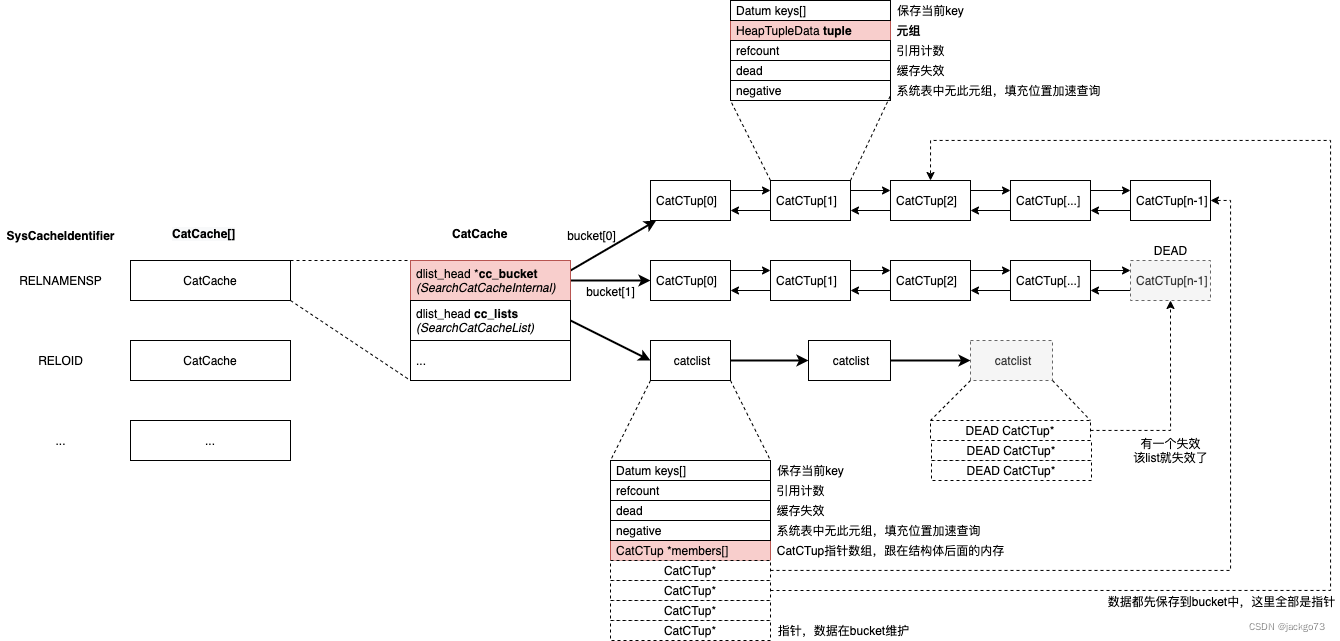
https://cloud.tencent.com/developer/article/2000765?from_column=20421&from=20421
添加名称空间 buildNSItemFromTupleDesc
为什么 PG 需要“名称空间” (NSItem)?
两种别名方式
-
select a as x, b as y from tb; -
select x, y, c from tb as t(x, y);(仅 PG 支持)
在 PostgreSQL 中,这两种方式分别对应 “投影别名” 和 “数据源别名”。
| 方式 | 语法示例 | 生效阶段 | 核心作用 |
|---|---|---|---|
| 投影别名 | select a AS x ... |
输出层 (Output) | 修饰性:重命名输出列 |
| 数据源别名 | FROM tb AS t(x, y) |
输入层 (Input) | 结构性:重定义表结构标识 |
为什么需要数据源别名?
- 解决“无名数据”的定义问题
- 简化复杂查询的引用
- 表结构标识重命名
buildRelationAliases 合并用户定义的别名和原列名形成完整的别名结构 Alias 保存到 RTE 的 eref 字段
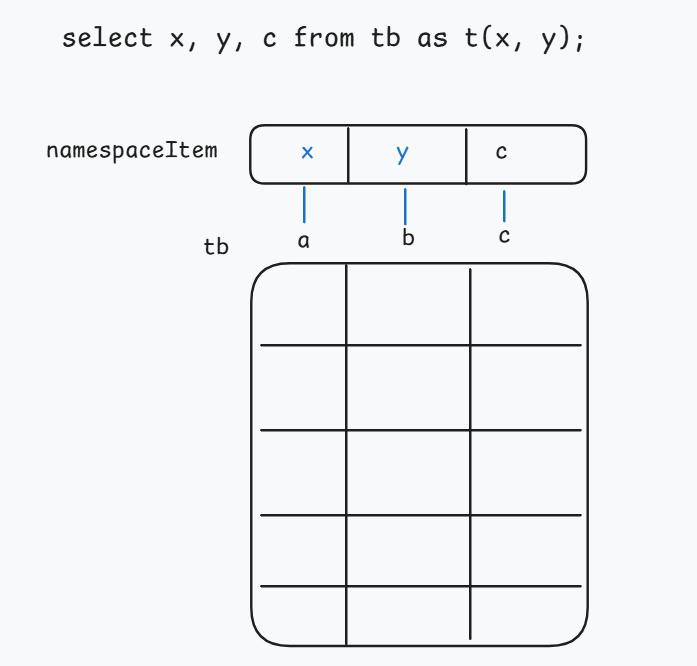
分析列名 select a, b
qry->targetList = transformTargetList
transformTargetList /* parser/parse_target.c */
    transformTargetEntry
        transformExpr --> expr/* parser/parser_expr.c */
            transformExprRecurse
                transformColumnRef
                    colNameToVar /* parser/parser_relation.c*/
                        scanNSItemForColumn
                            scanRTEForColumn /* Scan the nsitem's column names (or aliases) for a match */
                                foreach(c, eref->colnames) /* Scan the user column names (or aliases) for a match */
                                specialAttNum(colname) /* quick check to see if name could be a system column */
                                    SystemAttributeByName /* ctid, xmin, cmin, xmax, cmax, tableoid */
                                SearchSysCacheExists2
                            makeVar
        makeTargetEntry
            tle->expr, tle->resno, tle->resname
            return TargetEntry
        FigureColname
        makeTargetEntry /* creates a TargetEntry node */
分析过滤条件 where a = 2
qual = transformWhereClause
操作符元数据查询,pg_operator 元数据中重点关注
select * from pg_operator where oprname = '=';

select * from pg_operator where oid = 96;

select * from pg_type where oid = 23;
prname: 操作符名称oprleft: 左操作符类型oidoprright: 右操作符类型oidoprcode: 操作符的函数实现
语义分析过程
transformWhereClause
    transformExpr
        transformExprRecurse
            transformAExprOp
                lexpr = transformExprRecurse(pstate, lexpr);
                    transformColumnRef
                rexpr = transformExprRecurse(pstate, rexpr);
                    make_const
                make_op
                    oper(pstate, opname, ltypeId, rtypeId, false, location);
                        make_oper_cache_key
                        find_oper_cache_entry
                result->opno = oprid(tup); /* pg_operator: oid=96 | oprname='=' | oprcode='int4eq' */
                result->opfuncid = opform->oprcode; /*op_proc: oid=65 | proname='int4eq' */
                result->args = args

qry->jointree = makeFromExpr(pstate->p_joinlist, qual);